Giant guitarfish
rhynchobatus djiddensis
In Stock
Common stock
Wild Caught
Moderate care
With Caution
SKU: ML-MF-0283
The Giant guitarfish is a fascinating blend of shark and ray, captivating aquatic enthusiasts.
Pricing for Verified Importers
Log in to see wholesale prices and order.
Export Size
up to 300.0 cm
Origin
Indo-Pacific
Temperature
24.0–28.0°C
Min. Tank Size
1,000 L
Salinity
30.000–35.000 ppt
pH
7.50–8.50
Diet
carnivore
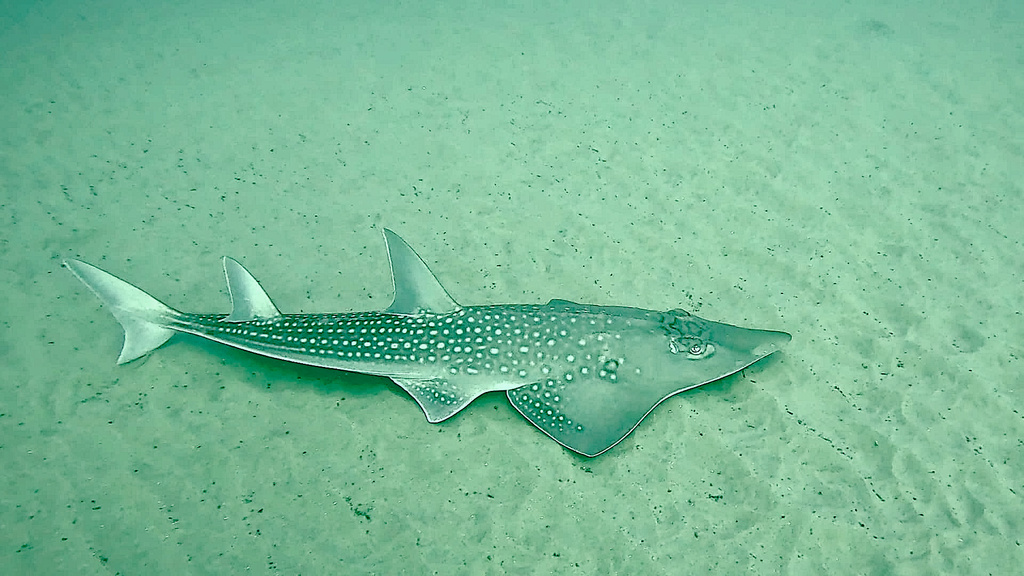
The Giant guitarfish (Rhynchobatus djiddensis) is an intriguing marine fish known for its unique flattened body shape, which resembles that of a ray. This species can be found in coastal waters of the Indo-Pacific, particularly around coral reefs, sandy bottoms, and estuaries. They are often seen resting on the seafloor, camouflaged against the substrate, which helps them evade predators and surprise their prey. A distinctive feature of the Giant guitarfish is its elongated snout, which aids in foraging for crustaceans and mollusks buried in the sand.
In terms of appearance, the Giant guitarfish can grow to impressive lengths, reaching up to 300 cm (approximately 10 feet). Their bodies are generally a light brown or greyish color with darker spots or patterns that further enhance their camouflage. This coloration allows them to blend seamlessly into their environments, making them less visible to both predators and prey alike. Juveniles often have more pronounced patterns, which tend to fade as they mature.
Giant guitarfish are generally solitary creatures but may be observed in small groups during certain times of the year, particularly during mating. They are bottom-dwellers and exhibit a unique behavior of burying themselves in the sand when threatened. Their diet primarily consists of small fish, crustaceans, and mollusks, which they hunt using their electroreception abilities to detect prey in the dark underwater environment.
These remarkable fish thrive in warm, shallow waters and are often found at depths of up to 30 meters. Their habitat preference includes coral reefs, sandy flats, and muddy bottoms, where they can find ample food sources while remaining hidden from larger predators. Conservation efforts are essential, as their populations are threatened by habitat loss and overfishing in some regions of their range.
In terms of appearance, the Giant guitarfish can grow to impressive lengths, reaching up to 300 cm (approximately 10 feet). Their bodies are generally a light brown or greyish color with darker spots or patterns that further enhance their camouflage. This coloration allows them to blend seamlessly into their environments, making them less visible to both predators and prey alike. Juveniles often have more pronounced patterns, which tend to fade as they mature.
Giant guitarfish are generally solitary creatures but may be observed in small groups during certain times of the year, particularly during mating. They are bottom-dwellers and exhibit a unique behavior of burying themselves in the sand when threatened. Their diet primarily consists of small fish, crustaceans, and mollusks, which they hunt using their electroreception abilities to detect prey in the dark underwater environment.
These remarkable fish thrive in warm, shallow waters and are often found at depths of up to 30 meters. Their habitat preference includes coral reefs, sandy flats, and muddy bottoms, where they can find ample food sources while remaining hidden from larger predators. Conservation efforts are essential, as their populations are threatened by habitat loss and overfishing in some regions of their range.
For aquarium importers and retailers, providing optimal care for the Giant guitarfish is crucial. A minimum tank size of 1000 liters is recommended to accommodate their large size and active swimming behavior. The ideal water parameters include a temperature range of 24-28°C, salinity between 30-35 ppt, and a pH level of 7.5 to 8.5. Regular water changes and filtration are necessary to maintain a healthy environment.
Feeding these fish requires a diet rich in protein. A varied diet of high-quality frozen or live foods, such as shrimp, fish, and squid, should be provided to ensure their nutritional needs are met. Compatibility with other species can be tricky; they may coexist with larger, non-aggressive fish but should be kept away from smaller species that they might prey upon.
During acclimation, it is essential to introduce them slowly to their new environment to minimize stress. Quarantine procedures are recommended before adding them to a display tank to prevent the spread of potential diseases. Monitoring their health and behavior during this period is vital for a successful transition.
Feeding these fish requires a diet rich in protein. A varied diet of high-quality frozen or live foods, such as shrimp, fish, and squid, should be provided to ensure their nutritional needs are met. Compatibility with other species can be tricky; they may coexist with larger, non-aggressive fish but should be kept away from smaller species that they might prey upon.
During acclimation, it is essential to introduce them slowly to their new environment to minimize stress. Quarantine procedures are recommended before adding them to a display tank to prevent the spread of potential diseases. Monitoring their health and behavior during this period is vital for a successful transition.
The Giant guitarfish is suitable for shipping; however, careful handling is essential due to their size and sensitivity to temperature fluctuations. It is recommended to use well-oxygenated bags with minimal packing density to reduce stress during transport. Maintain a shipping temperature between 22-26°C. This species is listed under CITES Appendix II, indicating that trade must be regulated to ensure sustainability.
Species Parameters
Max Adult Size
300.0 cm
Origin
Indo-Pacific
Diet
carnivore
Temp Min
24.0 °C
Temp Max
28.0 °C
Salinity Min
30.000
Salinity Max
35.000
pH Min
7.50
pH Max
8.50
Min Tank
1000 L