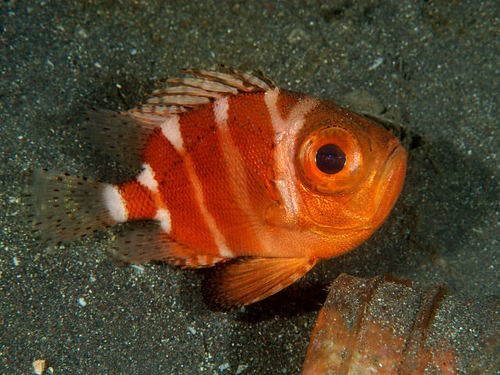
Japanese Bigeye
Pristigenys niphonia
In Stock
Common stock
Wild Caught
Moderate care
With Caution
SKU: CB-MF-0261
The Japanese Bigeye is a striking marine fish known for its vibrant colors and unique hunting behavior.
Pricing for Verified Importers
Log in to see wholesale prices and order.
Export Size
up to 30.0 cm
Origin
Indo-Pacific
Temperature
24.0–28.0°C
Min. Tank Size
200 L
Salinity
30.000–35.000 ppt
pH
8.10–8.40
Diet
carnivore
Pristigenys niphonia, commonly known as the Japanese Bigeye, is a distinctive marine fish native to the Indo-Pacific region. This species is easily recognizable due to its large, prominent eyes that enhance its vision in low-light conditions. The Japanese Bigeye exhibits a beautiful coloration, typically featuring a blend of yellow and blue hues along its body, making it an attractive addition to any aquarium setting. Additionally, its streamlined shape allows for agile movement, which is beneficial for both hunting and evading predators.
In terms of natural history, the Japanese Bigeye primarily inhabits rocky reefs and coral environments, where it can find ample hiding spots and abundant prey. This species is known to be a nocturnal hunter, often foraging for small crustaceans and fish during the night. Its behavior is characterized by a curious and sometimes bold demeanor, which allows it to explore its surroundings while also maintaining a watchful eye for potential threats.
The Japanese Bigeye plays a vital role in its ecosystem, serving as both predator and prey. Its presence indicates a healthy marine environment, as it relies on diverse habitats rich in biodiversity. As a schooling fish, it is often seen in small groups, adding a dynamic visual aspect to its natural habitat and to aquariums where they are housed together.
Overall, the Japanese Bigeye is not only an aesthetically pleasing species but also an important part of marine biodiversity that contributes to the ecological balance of its environment. Its unique adaptations and behaviors make it a fascinating species for both aquarists and researchers alike.
In terms of natural history, the Japanese Bigeye primarily inhabits rocky reefs and coral environments, where it can find ample hiding spots and abundant prey. This species is known to be a nocturnal hunter, often foraging for small crustaceans and fish during the night. Its behavior is characterized by a curious and sometimes bold demeanor, which allows it to explore its surroundings while also maintaining a watchful eye for potential threats.
The Japanese Bigeye plays a vital role in its ecosystem, serving as both predator and prey. Its presence indicates a healthy marine environment, as it relies on diverse habitats rich in biodiversity. As a schooling fish, it is often seen in small groups, adding a dynamic visual aspect to its natural habitat and to aquariums where they are housed together.
Overall, the Japanese Bigeye is not only an aesthetically pleasing species but also an important part of marine biodiversity that contributes to the ecological balance of its environment. Its unique adaptations and behaviors make it a fascinating species for both aquarists and researchers alike.
When caring for the Japanese Bigeye in an aquarium setting, it is essential to maintain optimal water parameters to ensure its health and vitality. The ideal temperature range for this species is between 24°C to 28°C, with a salinity level of 30 to 35 ppt. Regular monitoring of pH levels is also crucial, aiming for a range between 8.1 and 8.4. A minimum tank size of 200 liters is recommended to provide ample space for swimming and exploration.
Feeding the Japanese Bigeye should focus on a varied diet that includes high-quality pellets, live or frozen food such as brine shrimp, and small marine fish. Their carnivorous nature requires a protein-rich diet to support their growth and energy levels. It is advisable to feed them multiple times a day in small portions to mimic their natural foraging behavior.
Compatibility is generally good with other marine species, but caution should be exercised when mixing with aggressive fish. Acclimation should be done gradually, allowing the fish to adjust to the new environment over several hours. Quarantine new specimens before introducing them to an established tank to prevent the spread of diseases. This proactive approach will help maintain a healthy aquarium ecosystem and ensure the well-being of the Japanese Bigeye.
Feeding the Japanese Bigeye should focus on a varied diet that includes high-quality pellets, live or frozen food such as brine shrimp, and small marine fish. Their carnivorous nature requires a protein-rich diet to support their growth and energy levels. It is advisable to feed them multiple times a day in small portions to mimic their natural foraging behavior.
Compatibility is generally good with other marine species, but caution should be exercised when mixing with aggressive fish. Acclimation should be done gradually, allowing the fish to adjust to the new environment over several hours. Quarantine new specimens before introducing them to an established tank to prevent the spread of diseases. This proactive approach will help maintain a healthy aquarium ecosystem and ensure the well-being of the Japanese Bigeye.
The Japanese Bigeye is suitable for shipping, provided that proper packing methods are employed. It is recommended to use insulated boxes with adequate oxygen supply to maintain a stable environment during transit. Packing density should be kept low to minimize stress, ideally one fish per 10 liters of water. Temperature sensitivity is moderate; thus, maintaining a stable temperature between 24°C to 28°C is essential during shipping. Currently, there are no specific CITES regulations affecting this species.
Species Parameters
Max Adult Size
30.0 cm
Origin
Indo-Pacific
Diet
carnivore
Temp Min
24.0 °C
Temp Max
28.0 °C
Salinity Min
30.000
Salinity Max
35.000
pH Min
8.10
pH Max
8.40
Min Tank
200 L