Two-Banded Grouper
Diploprion bifasciatus
In Stock
Common stock
Wild Caught
Moderate care
With Caution
SKU: CB-MF-0366
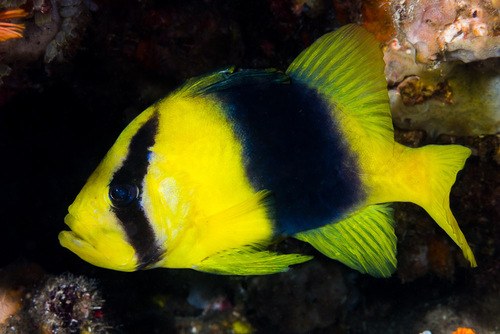
The Two-Banded Grouper is a striking marine fish known for its vibrant coloration and fascinating behavior.
Pricing for Verified Importers
Log in to see wholesale prices and order.
Export Size
up to 30.0 cm
Origin
Indo-Pacific
Temperature
24.0–28.0°C
Min. Tank Size
200 L
Salinity
1.020–1.025 ppt
pH
8.10–8.40
Diet
carnivore
The Two-Banded Grouper (Diploprion bifasciatus), also referred to as the barred soapfish, is a captivating species native to the warm waters of the Indo-Pacific region. With its distinctive yellow and brown bands, this grouper stands out among its peers, making it a sought-after addition for marine aquariums. Adults typically reach sizes of up to 30 cm, displaying a robust body and a notable head shape, which is characteristic of the Serranidae family. Their coloration can vary depending on their habitat, providing a dynamic visual appeal in aquarium settings.
In terms of behavior, Two-Banded Groupers are generally known for their solitary nature, preferring to inhabit rocky or coral reef environments. They are opportunistic feeders, primarily preying on small fish and crustaceans. This predatory behavior is complemented by their ability to blend into their surroundings, using their coloration for camouflage against potential threats. In the wild, they often establish territories, making them interesting specimens for observation in aquarium environments.
Habitat-wise, these groupers are typically found at depths ranging from 1 to 50 meters, often in areas with abundant cover provided by corals and rocks. Their preference for such environments makes them vital to the health of coral reef ecosystems, as they help control the populations of smaller fish and invertebrates. The Two-Banded Grouper is also known to exhibit specific breeding behaviors, often forming pairs during mating seasons, further enhancing their allure for aquarium enthusiasts.
Overall, the Two-Banded Grouper is not only a visually striking species but also plays a significant role in marine biodiversity. Its fascinating behavior and adaptability to aquarium life make it a valuable species for importers and retailers alike.
In terms of behavior, Two-Banded Groupers are generally known for their solitary nature, preferring to inhabit rocky or coral reef environments. They are opportunistic feeders, primarily preying on small fish and crustaceans. This predatory behavior is complemented by their ability to blend into their surroundings, using their coloration for camouflage against potential threats. In the wild, they often establish territories, making them interesting specimens for observation in aquarium environments.
Habitat-wise, these groupers are typically found at depths ranging from 1 to 50 meters, often in areas with abundant cover provided by corals and rocks. Their preference for such environments makes them vital to the health of coral reef ecosystems, as they help control the populations of smaller fish and invertebrates. The Two-Banded Grouper is also known to exhibit specific breeding behaviors, often forming pairs during mating seasons, further enhancing their allure for aquarium enthusiasts.
Overall, the Two-Banded Grouper is not only a visually striking species but also plays a significant role in marine biodiversity. Its fascinating behavior and adaptability to aquarium life make it a valuable species for importers and retailers alike.
For successful care of the Two-Banded Grouper in captivity, maintaining optimal water conditions is crucial. The ideal temperature range is between 24°C to 28°C, with a salinity level of 1.020 to 1.025 ppt. The pH should be kept between 8.1 and 8.4. A minimum tank size of 200 liters is recommended to provide ample space for swimming and territorial behavior.
Feeding should consist of a varied diet rich in protein, including high-quality pellets, frozen or live foods such as shrimp, and small fish to ensure optimal health. Due to their predatory nature, it is essential to avoid housing them with smaller fish that may be viewed as prey. Acclimation should be gradual, ideally over a period of 2-3 hours, to reduce stress and ensure a smooth transition to their new environment.
Quarantine is recommended for new arrivals, lasting at least 2-4 weeks to monitor for any signs of disease or stress before introducing them to the main tank. Regular water quality checks and maintenance are also necessary to keep the grouper healthy in a captive setting.
Feeding should consist of a varied diet rich in protein, including high-quality pellets, frozen or live foods such as shrimp, and small fish to ensure optimal health. Due to their predatory nature, it is essential to avoid housing them with smaller fish that may be viewed as prey. Acclimation should be gradual, ideally over a period of 2-3 hours, to reduce stress and ensure a smooth transition to their new environment.
Quarantine is recommended for new arrivals, lasting at least 2-4 weeks to monitor for any signs of disease or stress before introducing them to the main tank. Regular water quality checks and maintenance are also necessary to keep the grouper healthy in a captive setting.
The Two-Banded Grouper is suitable for shipping, provided proper care is taken to ensure their well-being during transit. Packing density should allow for adequate water exchange and oxygenation, typically one fish per 10 liters of water. Temperature sensitivity requires maintaining a stable temperature between 24°C and 28°C during shipping. This species is not listed under CITES, simplifying export regulations.
Species Parameters
Max Adult Size
30.0 cm
Origin
Indo-Pacific
Diet
carnivore
Temp Min
24.0 °C
Temp Max
28.0 °C
Salinity Min
1.020
Salinity Max
1.025
pH Min
8.10
pH Max
8.40
Min Tank
200 L