Royal Dottyback
Pictichromis paccagnella
In Stock
Common stock
Wild Caught
Moderate care
With Caution
SKU: CB-MF-0246
The Royal Dottyback is a vibrant marine fish known for its striking colors and territorial behavior.
Pricing for Verified Importers
Log in to see wholesale prices and order.
Export Size
up to 8.0 cm
Origin
Indo-Pacific
Temperature
24.0–28.0°C
Min. Tank Size
100 L
Salinity
1.020–1.025 ppt
pH
8.10–8.40
Diet
carnivore
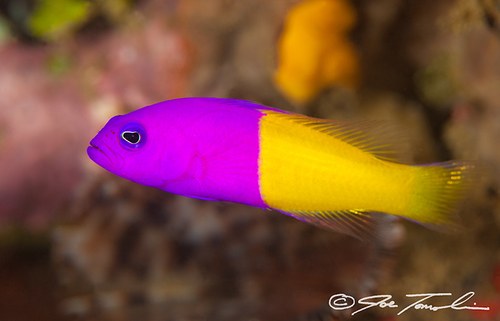
The Royal Dottyback (Pictichromis paccagnella) is a small, vibrant marine fish native to the coral reefs of the Indo-Pacific region. This species is characterized by its stunning coloration, typically featuring a bright purple body with a striking yellow tail and orange accents. These colors not only make them visually appealing but also serve as a warning to potential predators about their territorial nature. Adult Dottybacks can reach a maximum size of approximately 8 cm, making them a suitable choice for both home aquariums and larger commercial setups.
In the wild, Royal Dottybacks inhabit reef environments, often found hiding among the crevices and caves of coral structures. They are known for their aggressive territorial behavior, particularly during breeding seasons when males will defend their nesting sites fiercely. Dottybacks are also known to form monogamous pairs, showcasing complex courtship behaviors that can be fascinating to observe. Their natural habitats provide them with ample hiding spots, which are essential for their survival against larger predatory fish.
In terms of behavior, Royal Dottybacks are generally active swimmers and can be seen darting in and out of their hiding spots. They exhibit a curious nature and can adapt well to aquarium life, although their territorial tendencies may lead to aggression towards similarly sized fish. Providing adequate space and hiding spots is crucial for their well-being in captivity, ensuring they feel secure in their environment.
Overall, the Royal Dottyback is an attractive and engaging addition to marine aquariums, captivating hobbyists and professionals alike with its dynamic personality and exceptional beauty.
In the wild, Royal Dottybacks inhabit reef environments, often found hiding among the crevices and caves of coral structures. They are known for their aggressive territorial behavior, particularly during breeding seasons when males will defend their nesting sites fiercely. Dottybacks are also known to form monogamous pairs, showcasing complex courtship behaviors that can be fascinating to observe. Their natural habitats provide them with ample hiding spots, which are essential for their survival against larger predatory fish.
In terms of behavior, Royal Dottybacks are generally active swimmers and can be seen darting in and out of their hiding spots. They exhibit a curious nature and can adapt well to aquarium life, although their territorial tendencies may lead to aggression towards similarly sized fish. Providing adequate space and hiding spots is crucial for their well-being in captivity, ensuring they feel secure in their environment.
Overall, the Royal Dottyback is an attractive and engaging addition to marine aquariums, captivating hobbyists and professionals alike with its dynamic personality and exceptional beauty.
When caring for Royal Dottybacks, maintaining optimal water parameters is essential for their health and well-being. The recommended temperature range is between 24°C and 28°C, with a salinity level of 1.020 to 1.025 ppt. The pH should be maintained between 8.1 and 8.4, and a minimum tank size of 100 liters is advisable to accommodate their territorial nature and active swimming habits.
Feeding Royal Dottybacks requires a varied diet to ensure their nutritional needs are met. A mix of high-quality marine flakes, frozen mysis shrimp, and brine shrimp is ideal. They are primarily carnivorous, so ensuring a protein-rich diet will promote their health and vibrant coloration. It is important to feed them small amounts several times a day rather than one large feeding to mimic their natural foraging behavior.
Compatibility is crucial when introducing Royal Dottybacks to a community tank. While they can coexist with other species, caution should be taken with similarly sized or shaped fish, as they may display aggression. Acclimation should be done slowly, using a drip method over several hours to minimize stress. Quarantine new specimens for at least two weeks before introducing them to the main display tank to prevent the spread of diseases.
Overall, with the right care, Royal Dottybacks can thrive in both home aquariums and commercial setups, providing beauty and dynamic interactions for their keepers.
Feeding Royal Dottybacks requires a varied diet to ensure their nutritional needs are met. A mix of high-quality marine flakes, frozen mysis shrimp, and brine shrimp is ideal. They are primarily carnivorous, so ensuring a protein-rich diet will promote their health and vibrant coloration. It is important to feed them small amounts several times a day rather than one large feeding to mimic their natural foraging behavior.
Compatibility is crucial when introducing Royal Dottybacks to a community tank. While they can coexist with other species, caution should be taken with similarly sized or shaped fish, as they may display aggression. Acclimation should be done slowly, using a drip method over several hours to minimize stress. Quarantine new specimens for at least two weeks before introducing them to the main display tank to prevent the spread of diseases.
Overall, with the right care, Royal Dottybacks can thrive in both home aquariums and commercial setups, providing beauty and dynamic interactions for their keepers.
Royal Dottybacks are suitable for shipping due to their hardiness, but care must be taken to ensure they are packed securely to minimize stress during transport. Optimal packing density should allow for adequate water circulation while preventing overcrowding. They are sensitive to temperature fluctuations, so maintaining a stable environment during shipping is crucial. Ensure compliance with CITES regulations if applicable to your export.
Species Parameters
Max Adult Size
8.0 cm
Origin
Indo-Pacific
Diet
carnivore
Temp Min
24.0 °C
Temp Max
28.0 °C
Salinity Min
1.020
Salinity Max
1.025
pH Min
8.10
pH Max
8.40
Min Tank
100 L