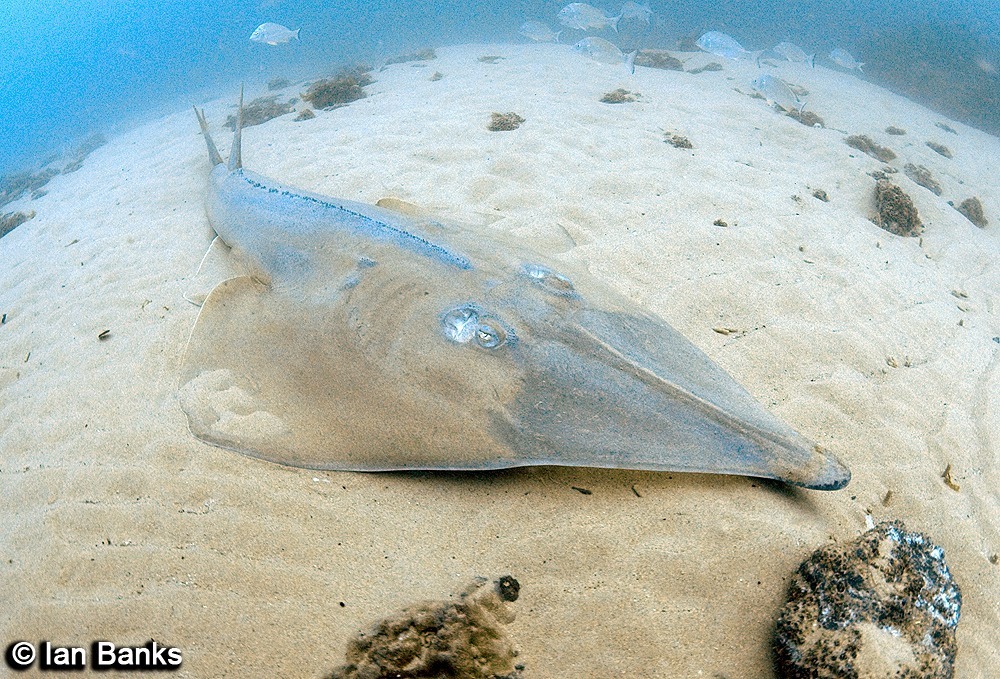
Giant Shovelnose Ray/Clearnose Guitar Ray
glaucostegus typus
In Stock
Common stock
Wild Caught
Moderate care
With Caution
SKU: ML-MF-0278
Discover the majestic Giant Shovelnose Ray, an intriguing marvel of the marine world.
Pricing for Verified Importers
Log in to see wholesale prices and order.
Export Size
up to 250.0 cm
Origin
Indo-Pacific
Temperature
24.0–28.0°C
Min. Tank Size
1,000 L
Salinity
30.000–35.000 ppt
pH
7.50–8.50
Diet
carnivore
The Giant Shovelnose Ray, also known as the Clearnose Guitar Ray (glaucostegus typus), is a remarkable species known for its distinctive flattened body and long, pointed snout. This ray showcases a unique blend of beauty and functionality, with a coloration that typically ranges from sandy brown to grey, adorned with lighter spots, providing excellent camouflage against the ocean floor. As one of the largest members of the ray family, it can reach sizes of up to 2.5 meters in length, making it a standout in any marine display.
In terms of natural history, the Giant Shovelnose Ray inhabits shallow coastal waters, typically found in sandy or muddy substrates where it can hunt for prey. This species is primarily nocturnal, utilizing its acute senses to detect crustaceans, mollusks, and small fish. Its flattened body allows for efficient movement over the seabed, while its large pectoral fins enable graceful gliding through the water.
Behaviorally, these rays are known for their social nature, often found in small groups or pairs. They exhibit a fascinating range of movements, from hovering near the substrate to swift bursts of speed when evading predators. Their unique feeding habits, which include a gentle suction of prey from the seabed, contribute to their adaptability in various marine environments.
The Giant Shovelnose Ray is predominantly found in the Indo-Pacific region, thriving in estuaries, lagoons, and coral reef systems. They are an integral part of the marine ecosystem, contributing to the health of seafloor communities by controlling prey populations and maintaining ecological balance.
In terms of natural history, the Giant Shovelnose Ray inhabits shallow coastal waters, typically found in sandy or muddy substrates where it can hunt for prey. This species is primarily nocturnal, utilizing its acute senses to detect crustaceans, mollusks, and small fish. Its flattened body allows for efficient movement over the seabed, while its large pectoral fins enable graceful gliding through the water.
Behaviorally, these rays are known for their social nature, often found in small groups or pairs. They exhibit a fascinating range of movements, from hovering near the substrate to swift bursts of speed when evading predators. Their unique feeding habits, which include a gentle suction of prey from the seabed, contribute to their adaptability in various marine environments.
The Giant Shovelnose Ray is predominantly found in the Indo-Pacific region, thriving in estuaries, lagoons, and coral reef systems. They are an integral part of the marine ecosystem, contributing to the health of seafloor communities by controlling prey populations and maintaining ecological balance.
For importers and retailers, providing optimal care for the Giant Shovelnose Ray is essential. Water parameters should be carefully monitored, with a temperature range of 24-28°C, pH levels between 7.5 and 8.5, and salinity levels between 30-35 ppt. A spacious tank of at least 1000 liters is recommended, mimicking their natural habitat with ample sandy substrate for burrowing and hiding.
Feeding these rays requires a carnivorous diet consisting of high-quality marine fish, crustaceans, and squid. It is advisable to offer a varied diet to ensure proper nutrition and health. When introducing new rays to a tank, acclimation should be gradual, utilizing drip acclimation methods to minimize stress. Compatibility with other species is generally good, but caution should be exercised with smaller fish that may be viewed as prey.
Quarantine procedures are crucial for new arrivals to prevent the introduction of diseases. A separate quarantine tank should be maintained for at least two weeks, with regular monitoring for signs of illness before introducing them to the main display.
Feeding these rays requires a carnivorous diet consisting of high-quality marine fish, crustaceans, and squid. It is advisable to offer a varied diet to ensure proper nutrition and health. When introducing new rays to a tank, acclimation should be gradual, utilizing drip acclimation methods to minimize stress. Compatibility with other species is generally good, but caution should be exercised with smaller fish that may be viewed as prey.
Quarantine procedures are crucial for new arrivals to prevent the introduction of diseases. A separate quarantine tank should be maintained for at least two weeks, with regular monitoring for signs of illness before introducing them to the main display.
The Giant Shovelnose Ray is suitable for shipping with proper care. It requires a secure, spacious packing arrangement to accommodate its size and movement. Temperature should be maintained between 24-26°C during transit to minimize stress. As this species is not listed under CITES, shipping regulations are less stringent, but compliance with local and international regulations is still essential.
Species Parameters
Max Adult Size
250.0 cm
Origin
Indo-Pacific
Diet
carnivore
Temp Min
24.0 °C
Temp Max
28.0 °C
Salinity Min
30.000
Salinity Max
35.000
pH Min
7.50
pH Max
8.50
Min Tank
1000 L