Cleaner Wrasse
Labroides dimidiatus
Limited
Occasional stock
Wild Caught
Moderate care
Reef Safe ✓
SKU: D097
The Cleaner Wrasse is a vital reef inhabitant known for its unique mutualistic behavior.
Pricing for Verified Importers
Log in to see wholesale prices and order.
Export Size
up to 11.0 cm
Origin
Indo-Pacific
Temperature
24.0–28.0°C
Min. Tank Size
100 L
Salinity
1.020–1.025 ppt
pH
8.10–8.40
Diet
carnivore
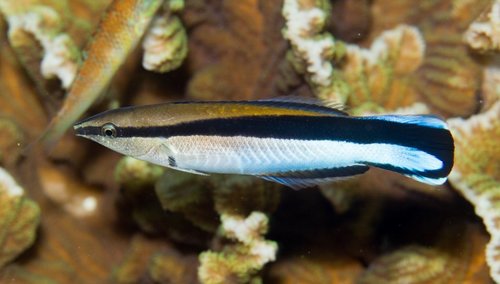
The Cleaner Wrasse (Labroides dimidiatus), also known as the bluestreak cleaner wrasse, is a remarkable marine fish found predominantly on coral reefs across the Indo-Pacific region, ranging from Eastern Africa and the Red Sea to French Polynesia. This species exhibits a striking blue and yellow coloration, which makes it easily recognizable among its reef companions. Its elongated body can reach a maximum size of about 11 cm, making it an attractive addition to any marine aquarium.
Cleaner wrasses are renowned for their unique role in the ecosystem as cleaners. They engage in a mutualistic relationship with larger fish species by feeding on parasites, dead tissue, and mucus found on their skin. This relationship benefits both parties: the larger fish receive essential health care, while the wrasse secures a reliable food source. Their behavior is fascinating, often displaying complex social interactions and even showing signs of recognition among different fish species.
Typically found in shallow waters of coral reefs, Cleaner Wrasses prefer areas with abundant fish populations and plenty of hiding spots among the coral. They thrive in diverse environments, often seen darting in and out of crevices as they service their clients. Their presence is crucial in maintaining the health of reef ecosystems, as they help control parasite populations that could otherwise harm larger fish.
In addition to their ecological importance, Cleaner Wrasses have garnered attention for their cognitive abilities, as evidenced by their passing of the mirror test, a measure of self-awareness. This unique combination of ecological role and intelligence makes them a fascinating species for both researchers and aquarium enthusiasts alike.
Cleaner wrasses are renowned for their unique role in the ecosystem as cleaners. They engage in a mutualistic relationship with larger fish species by feeding on parasites, dead tissue, and mucus found on their skin. This relationship benefits both parties: the larger fish receive essential health care, while the wrasse secures a reliable food source. Their behavior is fascinating, often displaying complex social interactions and even showing signs of recognition among different fish species.
Typically found in shallow waters of coral reefs, Cleaner Wrasses prefer areas with abundant fish populations and plenty of hiding spots among the coral. They thrive in diverse environments, often seen darting in and out of crevices as they service their clients. Their presence is crucial in maintaining the health of reef ecosystems, as they help control parasite populations that could otherwise harm larger fish.
In addition to their ecological importance, Cleaner Wrasses have garnered attention for their cognitive abilities, as evidenced by their passing of the mirror test, a measure of self-awareness. This unique combination of ecological role and intelligence makes them a fascinating species for both researchers and aquarium enthusiasts alike.
When caring for Cleaner Wrasses in an aquarium setting, it is essential to replicate their natural habitat as closely as possible. They thrive in water temperatures ranging from 24°C to 28°C, with a salinity level between 1.020 and 1.025 ppt. The pH levels should be maintained between 8.1 and 8.4 to ensure optimal health. A minimum tank size of 100 liters is recommended to provide adequate swimming space and hiding spots.
Feeding Cleaner Wrasses requires a varied diet that includes high-quality frozen or live foods, such as brine shrimp, mysis shrimp, and specialized cleaner fish pellets. Regular feeding is essential to keep them healthy and encourage their natural cleaning behavior. It is advisable to introduce them to the aquarium after other fish to reduce territorial disputes.
In terms of compatibility, Cleaner Wrasses are generally peaceful but can be territorial, especially towards their own species. They do best in a community tank with other non-aggressive fish. Acclimation should be done gradually to minimize stress, and a quarantine period of at least two weeks is recommended to ensure they are disease-free before introducing them to the main display tank.
Feeding Cleaner Wrasses requires a varied diet that includes high-quality frozen or live foods, such as brine shrimp, mysis shrimp, and specialized cleaner fish pellets. Regular feeding is essential to keep them healthy and encourage their natural cleaning behavior. It is advisable to introduce them to the aquarium after other fish to reduce territorial disputes.
In terms of compatibility, Cleaner Wrasses are generally peaceful but can be territorial, especially towards their own species. They do best in a community tank with other non-aggressive fish. Acclimation should be done gradually to minimize stress, and a quarantine period of at least two weeks is recommended to ensure they are disease-free before introducing them to the main display tank.
Cleaner Wrasses are suitable for shipping, provided they are packed securely to minimize stress during transit. A packing density of 1-2 fish per liter is recommended to ensure adequate space. They are temperature-sensitive and should be shipped at temperatures between 24°C and 28°C. This species is not listed under CITES, making export regulations straightforward.
Species Parameters
Max Adult Size
11.0 cm
Origin
Indo-Pacific
Habitat
reef
Diet
carnivore
Temp Min
24.0 °C
Temp Max
28.0 °C
Salinity Min
1.020
Salinity Max
1.025
pH Min
8.10
pH Max
8.40
Min Tank
100 L