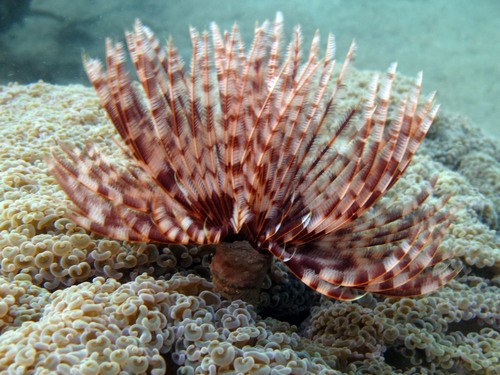

Red White Feather Duster Hardtube
Protula Spec.
In Stock
Common stock
Wild Caught
Moderate care
SKU: CB-SC-0146
The Red White Feather Duster Hardtube is a stunning invertebrate with unique colors and filtration abilities.
Pricing for Verified Importers
Log in to see wholesale prices and order.
Export Size
up to 15.0 cm
Origin
Indo-Pacific
Temperature
24.0–28.0°C
Min. Tank Size
50 L
pH
7.80–8.50
The Red White Feather Duster Hardtube (Protula spec.) is an exquisite marine invertebrate known for its vibrant red and white plumes that resemble delicate feathers. These colorful structures are not only visually striking but also serve a crucial function in the animal's life. Found predominantly in coral reef environments, this species builds a hard, calcareous tube that provides protection and stability while it filters food particles from the water. The combination of its beautiful appearance and essential ecological role makes it a standout choice for aquarists looking to enhance their tanks.
In terms of natural history, the Red White Feather Duster Hardtube is primarily a filter feeder, utilizing its feather-like crowns to capture plankton and organic debris. These creatures are often found in sandy or muddy substrates, where they can anchor their tubes securely. Their feeding behavior is highly efficient, allowing them to thrive in various marine conditions. They are known to be relatively hardy and can adapt to different environments, making them a popular choice among aquarium enthusiasts.
Behaviorally, the Red White Feather Duster Hardtube is generally peaceful and can coexist with a variety of tank mates, provided they are not overly aggressive. They tend to retract their plumes into their tubes when disturbed, showcasing their defensive behavior. This retractable feature is a fascinating aspect of their biology, allowing them to protect themselves from potential threats. The presence of these duster worms can also encourage biodiversity in aquariums, as they create microhabitats for other smaller organisms.
Habitat-wise, these invertebrates are typically found in shallow waters of the Indo-Pacific region, particularly in areas rich in coral reefs. The combination of warm temperatures and abundant food sources in these environments supports their growth and reproduction. Importers and retailers can greatly benefit from understanding their natural habitat, as replicating these conditions in captivity will enhance the well-being of these stunning creatures.
In terms of natural history, the Red White Feather Duster Hardtube is primarily a filter feeder, utilizing its feather-like crowns to capture plankton and organic debris. These creatures are often found in sandy or muddy substrates, where they can anchor their tubes securely. Their feeding behavior is highly efficient, allowing them to thrive in various marine conditions. They are known to be relatively hardy and can adapt to different environments, making them a popular choice among aquarium enthusiasts.
Behaviorally, the Red White Feather Duster Hardtube is generally peaceful and can coexist with a variety of tank mates, provided they are not overly aggressive. They tend to retract their plumes into their tubes when disturbed, showcasing their defensive behavior. This retractable feature is a fascinating aspect of their biology, allowing them to protect themselves from potential threats. The presence of these duster worms can also encourage biodiversity in aquariums, as they create microhabitats for other smaller organisms.
Habitat-wise, these invertebrates are typically found in shallow waters of the Indo-Pacific region, particularly in areas rich in coral reefs. The combination of warm temperatures and abundant food sources in these environments supports their growth and reproduction. Importers and retailers can greatly benefit from understanding their natural habitat, as replicating these conditions in captivity will enhance the well-being of these stunning creatures.
For optimal care of the Red White Feather Duster Hardtube, maintain water parameters that reflect their natural environment. Ideal temperature ranges from 24°C to 28°C, with a pH level between 7.8 and 8.5. As a filter feeder, they thrive in stable water conditions with minimal fluctuations. Salinity is not applicable as this species is freshwater.
Feeding should include a diet rich in fine particulate matter, such as phytoplankton or specialized filter feeder foods, which can be dosed into the water column. Regular feeding will support their overall health and promote growth. Compatibility with other species is generally good, as they are non-aggressive and can coexist with a variety of tank mates, though care should be taken to avoid predatory fish that may disrupt their feeding behavior.
Acclimation is crucial; it is recommended to use a slow drip method over several hours when introducing them to a new tank to minimize stress. Quarantine should be practiced to prevent potential diseases from affecting the main aquarium. This involves keeping the feather duster in a separate tank for a minimum of two weeks, monitoring for any signs of illness before adding it to the display tank.
Feeding should include a diet rich in fine particulate matter, such as phytoplankton or specialized filter feeder foods, which can be dosed into the water column. Regular feeding will support their overall health and promote growth. Compatibility with other species is generally good, as they are non-aggressive and can coexist with a variety of tank mates, though care should be taken to avoid predatory fish that may disrupt their feeding behavior.
Acclimation is crucial; it is recommended to use a slow drip method over several hours when introducing them to a new tank to minimize stress. Quarantine should be practiced to prevent potential diseases from affecting the main aquarium. This involves keeping the feather duster in a separate tank for a minimum of two weeks, monitoring for any signs of illness before adding it to the display tank.
The Red White Feather Duster Hardtube is sensitive to temperature fluctuations, so it is essential to ship them in temperature-controlled environments. Packing density should be moderate to prevent damage during transit. Ensure adequate water circulation and oxygen levels are maintained throughout shipping. This species is not listed under CITES, making export simpler, but adherence to local regulations is necessary.
Species Parameters
Max Adult Size
15.0 cm
Origin
Indo-Pacific
Temp Min
24.0 °C
Temp Max
28.0 °C
pH Min
7.80
pH Max
8.50
Min Tank
50 L