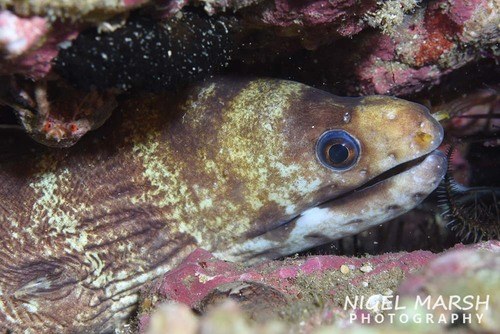
Barred Morray
Echidna polyzona
In Stock
Common stock
Wild Caught
Moderate care
With Caution
SKU: CB-MF-0388
Discover the captivating Barred Morray, a unique and colorful addition to marine aquariums.
Pricing for Verified Importers
Log in to see wholesale prices and order.
Export Size
up to 100.0 cm
Origin
Indo-Pacific
Temperature
24.0–28.0°C
Min. Tank Size
200 L
Salinity
1.020–1.025 ppt
pH
8.10–8.40
Diet
carnivore
The Barred Morray (Echidna polyzona) is a striking marine fish renowned for its vibrant colors and unique patterning. Characterized by its elongated body and distinctive bars, this species boasts a rich combination of yellows, browns, and blacks, making it a visually stunning inhabitant of the reef. As a member of the Muraenidae family, the Barred Morray exhibits a fascinating morphology, including a broad, flat head and keen eyesight, adapted for hunting in its natural habitat.
Native to the coral reefs of the Indo-Pacific region, the Barred Morray thrives in warm, shallow waters where it can find ample shelter among rocky crevices and coral formations. This species is primarily nocturnal, emerging at night to hunt for prey, which includes small fish and crustaceans. During the day, it often hides in its lair, displaying a shy demeanor that belies its predatory nature. The Barred Morray is known for its agility and speed in the water, allowing it to capture prey effectively.
In terms of behavior, the Barred Morray exhibits territorial tendencies, particularly when it comes to its habitat. It prefers to establish a home range within the reef, where it can assert dominance over its immediate surroundings. This species communicates through body movements and posturing, signaling its presence to both potential threats and competitors. While it can be aggressive towards other morays, it generally coexists peacefully with a variety of reef fish, provided there is enough space.
The Barred Morray's habitat is crucial for its survival, as it relies on the health of coral reefs for food and shelter. Unfortunately, these ecosystems are increasingly threatened by environmental changes, making the conservation of such species paramount. As a desirable species for both aquarium enthusiasts and researchers, the Barred Morray represents the intricate beauty and complexity of marine ecosystems.
Native to the coral reefs of the Indo-Pacific region, the Barred Morray thrives in warm, shallow waters where it can find ample shelter among rocky crevices and coral formations. This species is primarily nocturnal, emerging at night to hunt for prey, which includes small fish and crustaceans. During the day, it often hides in its lair, displaying a shy demeanor that belies its predatory nature. The Barred Morray is known for its agility and speed in the water, allowing it to capture prey effectively.
In terms of behavior, the Barred Morray exhibits territorial tendencies, particularly when it comes to its habitat. It prefers to establish a home range within the reef, where it can assert dominance over its immediate surroundings. This species communicates through body movements and posturing, signaling its presence to both potential threats and competitors. While it can be aggressive towards other morays, it generally coexists peacefully with a variety of reef fish, provided there is enough space.
The Barred Morray's habitat is crucial for its survival, as it relies on the health of coral reefs for food and shelter. Unfortunately, these ecosystems are increasingly threatened by environmental changes, making the conservation of such species paramount. As a desirable species for both aquarium enthusiasts and researchers, the Barred Morray represents the intricate beauty and complexity of marine ecosystems.
When caring for Barred Morrays, maintain water parameters that closely mimic their natural environment. Ideal temperature ranges from 24 to 28°C (75 to 82°F), and salinity levels should be between 1.020 to 1.025 ppt. The pH should be kept between 8.1 and 8.4. A minimum tank size of 200 liters is recommended to provide adequate swimming space and hiding spots.
Feeding a Barred Morray requires a diet rich in protein, making them carnivores that thrive on a variety of meaty foods. Offer a mix of high-quality frozen or live foods such as shrimp, fish, and squid. Regular feeding should occur 2-3 times a week to ensure optimal health and growth.
Compatibility is key; while Barred Morrays can coexist with various reef fish, caution should be exercised with smaller species, as they may be viewed as prey. Acclimation should be gradual to reduce stress; introduce them to the aquarium in a dimly lit environment. Quarantine new arrivals for at least two weeks to monitor for any signs of disease before adding them to the main tank.
Feeding a Barred Morray requires a diet rich in protein, making them carnivores that thrive on a variety of meaty foods. Offer a mix of high-quality frozen or live foods such as shrimp, fish, and squid. Regular feeding should occur 2-3 times a week to ensure optimal health and growth.
Compatibility is key; while Barred Morrays can coexist with various reef fish, caution should be exercised with smaller species, as they may be viewed as prey. Acclimation should be gradual to reduce stress; introduce them to the aquarium in a dimly lit environment. Quarantine new arrivals for at least two weeks to monitor for any signs of disease before adding them to the main tank.
Barred Morrays are suitable for shipping due to their hardy nature, but care must be taken to ensure they are packed securely to prevent injury. A packing density of 1 fish per 10 liters is recommended to minimize stress during transport. They are moderately temperature-sensitive, ideally shipped at temperatures between 24-26°C. Currently, there are no CITES restrictions for this species.
Species Parameters
Max Adult Size
100.0 cm
Origin
Indo-Pacific
Diet
carnivore
Temp Min
24.0 °C
Temp Max
28.0 °C
Salinity Min
1.020
Salinity Max
1.025
pH Min
8.10
pH Max
8.40
Min Tank
200 L