Spotted Eagle Ray
Aetobatus narinari
In Stock
Common stock
Wild Caught
Moderate care
With Caution
SKU: CB-MF-0399
The Spotted Eagle Ray is a stunning cartilaginous fish known for its unique spotted pattern and graceful swimming style.
Pricing for Verified Importers
Log in to see wholesale prices and order.
Export Size
up to 270.0 cm
Origin
Indo-Pacific
Temperature
24.0–28.0°C
Min. Tank Size
1,500 L
Salinity
30.000–35.000 ppt
pH
7.50–8.50
Diet
carnivore
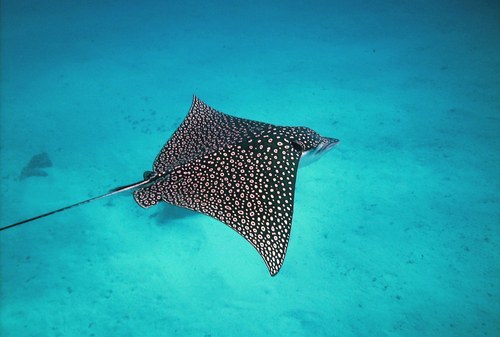
The Spotted Eagle Ray (Aetobatus narinari) belongs to the family Aetobatidae and is recognized for its distinctively patterned dorsal surface, featuring a mosaic of white spots against a dark background. This species typically reaches a maximum size of around 2.7 meters (8.9 feet) in wingspan, making it one of the more majestic inhabitants of tropical marine environments. The coloration not only serves an aesthetic purpose but also provides camouflage against predators in their natural habitat.
Spotted Eagle Rays are predominantly found in shallow coastal waters, including sandy and muddy bottoms, and often inhabit areas around coral reefs. They are distributed across tropical oceans, with populations primarily noted in the Atlantic, while some authorities recognize separate species in the Pacific. These rays exhibit a unique ovoviviparous reproductive strategy, where females retain fertilized eggs internally before giving birth to live young, which are miniature replicas of their parents.
Behaviorally, Spotted Eagle Rays are often observed swimming alone, although they can occasionally be seen in small groups. They are known for their graceful movement, gliding effortlessly through the water with their large pectoral fins, which resemble wings. Their diet predominantly consists of mollusks, crustaceans, and small fish, which they capture using their specialized feeding techniques, including the use of their flattened snouts to uncover prey from the substrate.
This species plays a vital role in maintaining the ecological balance of its habitat by controlling prey populations. They are also a popular sight for divers and snorkelers, making them a valuable species for ecotourism in regions where they are abundant. As such, the Spotted Eagle Ray is not just an essential component of marine biodiversity but also contributes significantly to local economies reliant on marine tourism.
Spotted Eagle Rays are predominantly found in shallow coastal waters, including sandy and muddy bottoms, and often inhabit areas around coral reefs. They are distributed across tropical oceans, with populations primarily noted in the Atlantic, while some authorities recognize separate species in the Pacific. These rays exhibit a unique ovoviviparous reproductive strategy, where females retain fertilized eggs internally before giving birth to live young, which are miniature replicas of their parents.
Behaviorally, Spotted Eagle Rays are often observed swimming alone, although they can occasionally be seen in small groups. They are known for their graceful movement, gliding effortlessly through the water with their large pectoral fins, which resemble wings. Their diet predominantly consists of mollusks, crustaceans, and small fish, which they capture using their specialized feeding techniques, including the use of their flattened snouts to uncover prey from the substrate.
This species plays a vital role in maintaining the ecological balance of its habitat by controlling prey populations. They are also a popular sight for divers and snorkelers, making them a valuable species for ecotourism in regions where they are abundant. As such, the Spotted Eagle Ray is not just an essential component of marine biodiversity but also contributes significantly to local economies reliant on marine tourism.
For successful care of Spotted Eagle Rays in captivity, it is crucial to replicate their natural habitat as closely as possible. Ideal water parameters include a temperature range of 24-28°C, salinity of 30-35 ppt, and a pH level between 7.5 and 8.5. A spacious tank of at least 1,500 liters is recommended to accommodate their size and swimming behavior. The substrate should consist of soft sand or fine gravel to prevent injury when they rest.
Feeding should consist of a varied diet comprising high-quality meaty foods such as shrimp, squid, and fish, supplemented with vitamins and minerals to ensure optimal health. Compatibility with other tank mates requires caution, as their size and feeding habits may pose risks to smaller fish. Acclimation to new environments should be gradual to minimize stress; a slow introduction over several hours is ideal. Quarantine new arrivals for at least two weeks to monitor for any signs of disease before adding them to main displays.
Overall, providing ample space, a suitable diet, and careful monitoring of water conditions is essential for maintaining the health and well-being of Spotted Eagle Rays in a captive setting.
Feeding should consist of a varied diet comprising high-quality meaty foods such as shrimp, squid, and fish, supplemented with vitamins and minerals to ensure optimal health. Compatibility with other tank mates requires caution, as their size and feeding habits may pose risks to smaller fish. Acclimation to new environments should be gradual to minimize stress; a slow introduction over several hours is ideal. Quarantine new arrivals for at least two weeks to monitor for any signs of disease before adding them to main displays.
Overall, providing ample space, a suitable diet, and careful monitoring of water conditions is essential for maintaining the health and well-being of Spotted Eagle Rays in a captive setting.
Spotted Eagle Rays are sensitive to temperature fluctuations and should be shipped at a stable temperature between 24-28°C. Packing should allow for sufficient water volume and aeration to maintain oxygen levels during transit. Given their size, a lower packing density is recommended to reduce stress. They are listed under CITES Appendix II, indicating that trade must be regulated to ensure sustainability.
Species Parameters
Max Adult Size
270.0 cm
Origin
Indo-Pacific
Diet
carnivore
Temp Min
24.0 °C
Temp Max
28.0 °C
Salinity Min
30.000
Salinity Max
35.000
pH Min
7.50
pH Max
8.50
Min Tank
1500 L