Blue Ring Octopus
Hapalochlaena maculosa
In Stock
Common stock
Wild Caught
Moderate care
With Caution
SKU: CB-MF-0429
The Blue Ring Octopus is a captivating yet highly venomous marine species known for its striking blue rings.
Pricing for Verified Importers
Log in to see wholesale prices and order.
Export Size
up to 20.0 cm
Origin
Indo-Pacific
Temperature
22.0–28.0°C
Min. Tank Size
100 L
Salinity
32.000–35.000 ppt
pH
8.10–8.40
Diet
carnivore
The Blue Ring Octopus (Hapalochlaena maculosa) is a small but fascinating marine creature predominantly found in tidal rock pools along the south coast of Australia and other Indo-Pacific regions, including Bali. This species typically reaches a maximum size of 20 centimeters (8 inches) and weighs around 26 grams (0.9 oz). Despite their small size, they possess one of the most potent venoms in the animal kingdom, making them both intriguing and potentially dangerous.
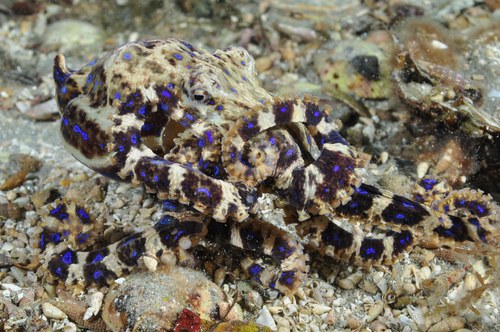
Visually, the Blue Ring Octopus is notable for its vibrant blue rings, which become more pronounced when the animal is agitated or threatened. These rings serve as a warning signal to potential predators. The octopus has a soft, flexible body that allows it to maneuver skillfully through rocky crevices and coral reefs. Its coloration can vary, enabling it to blend into its surroundings, an essential survival tactic against predators.
Behaviorally, Blue Ring Octopuses are generally docile and prefer to retreat rather than confront threats. They are primarily nocturnal hunters, using their keen eyesight to locate prey such as crabs, shrimp, and small fish. When hunting, these octopuses can employ various tactics, including ambush and camouflage, to surprise their unsuspecting prey. Their intelligence is notable, exhibiting problem-solving skills and curiosity.
Habitat-wise, they thrive in shallow waters, often hiding within rocky crevices, coral reefs, or under debris. This species is particularly sensitive to environmental changes, which makes their habitat conservation crucial for their survival. Importers and aquarists must ensure that their environments reflect the conditions of their natural habitats to maintain their health and well-being.
Visually, the Blue Ring Octopus is notable for its vibrant blue rings, which become more pronounced when the animal is agitated or threatened. These rings serve as a warning signal to potential predators. The octopus has a soft, flexible body that allows it to maneuver skillfully through rocky crevices and coral reefs. Its coloration can vary, enabling it to blend into its surroundings, an essential survival tactic against predators.
Behaviorally, Blue Ring Octopuses are generally docile and prefer to retreat rather than confront threats. They are primarily nocturnal hunters, using their keen eyesight to locate prey such as crabs, shrimp, and small fish. When hunting, these octopuses can employ various tactics, including ambush and camouflage, to surprise their unsuspecting prey. Their intelligence is notable, exhibiting problem-solving skills and curiosity.
Habitat-wise, they thrive in shallow waters, often hiding within rocky crevices, coral reefs, or under debris. This species is particularly sensitive to environmental changes, which makes their habitat conservation crucial for their survival. Importers and aquarists must ensure that their environments reflect the conditions of their natural habitats to maintain their health and well-being.
To successfully care for Blue Ring Octopuses in captivity, specific water parameters are crucial. The optimal temperature range is between 22°C to 28°C, with a salinity of 32-35 ppt. The pH level should be maintained between 8.1 and 8.4 to mimic their natural habitat. A minimum tank size of 100 liters is recommended to provide ample space for swimming and exploration.
These octopuses are carnivorous and should be fed a varied diet of live or frozen foods, including small crustaceans and fish. It is essential to feed them regularly, but caution should be taken to avoid overfeeding. Compatibility with other species can be challenging, as Blue Ring Octopuses may exhibit territorial behaviors, making them best suited for species-only tanks.
Acclimation is vital when introducing these octopuses to a new environment. Gradual acclimation to temperature and salinity changes will help reduce stress. A quarantine period of at least two weeks is also recommended to prevent the introduction of diseases into the main tank.
These octopuses are carnivorous and should be fed a varied diet of live or frozen foods, including small crustaceans and fish. It is essential to feed them regularly, but caution should be taken to avoid overfeeding. Compatibility with other species can be challenging, as Blue Ring Octopuses may exhibit territorial behaviors, making them best suited for species-only tanks.
Acclimation is vital when introducing these octopuses to a new environment. Gradual acclimation to temperature and salinity changes will help reduce stress. A quarantine period of at least two weeks is also recommended to prevent the introduction of diseases into the main tank.
Blue Ring Octopuses are sensitive to temperature fluctuations, so they should be shipped in insulated containers with oxygen and proper water parameters. Packing density should be low to prevent stress during transport. These octopuses are not listed under CITES but must be handled with caution due to their venomous nature. Ensure that all shipping regulations are followed to guarantee safe and humane transport.
Species Parameters
Max Adult Size
20.0 cm
Origin
Indo-Pacific
Diet
carnivore
Temp Min
22.0 °C
Temp Max
28.0 °C
Salinity Min
32.000
Salinity Max
35.000
pH Min
8.10
pH Max
8.40
Min Tank
100 L