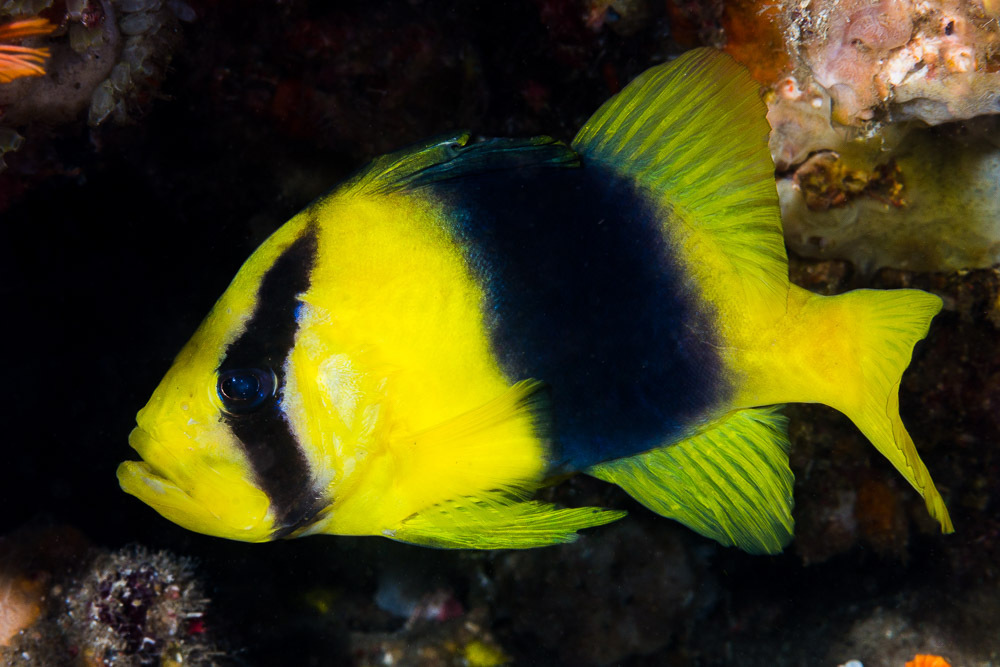
Barred soapfish/Double Banded soapfish JUV
diploprion bifasciatum juv.
In Stock
Common stock
Wild Caught
Moderate care
With Caution
SKU: ML-MF-0273
The Barred soapfish is a striking marine species known for its unique coloration and pattern.
Pricing for Verified Importers
Log in to see wholesale prices and order.
Export Size
up to 20.0 cm
Origin
Indo-Pacific
Temperature
24.0–28.0°C
Min. Tank Size
200 L
Salinity
1.020–1.025 ppt
pH
8.10–8.40
Diet
carnivore
The Barred soapfish, also known as the Double Banded soapfish (Diploprion bifasciatum juv.), is a captivating marine fish primarily found in the coral reefs of the Indo-Pacific region. This species is particularly notable during its juvenile stage, where it exhibits a vivid coloration of yellow and black bands that serve as an effective camouflage against predators in its natural habitat. As they mature, their colors tend to change, but the distinct banding remains a key identifying feature.
In terms of behavior, the Barred soapfish is generally a nocturnal species, often hiding among coral structures during the day. They are known to be somewhat shy and prefer to stay in sheltered areas, making them less visible but more fascinating to observe. This species primarily feeds on small invertebrates and crustaceans, showcasing its role in the marine ecosystem as both predator and prey.
Barred soapfish thrive in warm, shallow waters, typically found at depths ranging from 1 to 30 meters. Their preferred habitats include coral reefs and rocky substrates where they can find ample hiding spots. This species contributes to the biodiversity of the reef ecosystem, and its presence is an indicator of a healthy marine environment. Aquarists appreciate the Barred soapfish not only for its beauty but also for the unique dynamics it brings to a marine aquarium.
Overall, the Barred soapfish offers a combination of visual appeal and intriguing behavior, making it a desirable addition to both public aquariums and private collections. Its unique attributes and role within the marine ecosystem highlight its importance and charm as a species.
In terms of behavior, the Barred soapfish is generally a nocturnal species, often hiding among coral structures during the day. They are known to be somewhat shy and prefer to stay in sheltered areas, making them less visible but more fascinating to observe. This species primarily feeds on small invertebrates and crustaceans, showcasing its role in the marine ecosystem as both predator and prey.
Barred soapfish thrive in warm, shallow waters, typically found at depths ranging from 1 to 30 meters. Their preferred habitats include coral reefs and rocky substrates where they can find ample hiding spots. This species contributes to the biodiversity of the reef ecosystem, and its presence is an indicator of a healthy marine environment. Aquarists appreciate the Barred soapfish not only for its beauty but also for the unique dynamics it brings to a marine aquarium.
Overall, the Barred soapfish offers a combination of visual appeal and intriguing behavior, making it a desirable addition to both public aquariums and private collections. Its unique attributes and role within the marine ecosystem highlight its importance and charm as a species.
To successfully care for juvenile Barred soapfish, importers and retailers should ensure optimal water parameters that replicate their natural habitat. Ideal temperature ranges from 24°C to 28°C, with salinity levels between 1.020 and 1.025 ppt. The pH should be maintained between 8.1 and 8.4 for optimal health. It is essential to provide adequate swimming space, with a minimum tank size of 200 liters to accommodate their natural behavior.
Feeding juvenile Barred soapfish requires a diet rich in protein, as they are carnivorous. High-quality frozen or live foods such as brine shrimp, mysis shrimp, and small crustaceans are recommended to promote healthy growth and coloration. It is crucial to introduce new foods gradually to prevent stress and ensure proper acceptance.
In terms of compatibility, the Barred soapfish is generally peaceful but can be territorial, especially when it comes to its hiding spots. It is advisable to house them with similarly sized and temperament fish to minimize aggression. Acclimation should be conducted slowly over several hours to reduce stress, and a quarantine period of at least two weeks is recommended before introducing them to a main tank to monitor for any potential diseases.
Feeding juvenile Barred soapfish requires a diet rich in protein, as they are carnivorous. High-quality frozen or live foods such as brine shrimp, mysis shrimp, and small crustaceans are recommended to promote healthy growth and coloration. It is crucial to introduce new foods gradually to prevent stress and ensure proper acceptance.
In terms of compatibility, the Barred soapfish is generally peaceful but can be territorial, especially when it comes to its hiding spots. It is advisable to house them with similarly sized and temperament fish to minimize aggression. Acclimation should be conducted slowly over several hours to reduce stress, and a quarantine period of at least two weeks is recommended before introducing them to a main tank to monitor for any potential diseases.
Barred soapfish are sensitive to temperature fluctuations, making careful shipping essential. They should be packed in insulated containers with adequate oxygen supply and maintained at temperatures between 24°C and 26°C during transit. The recommended packing density is 1-2 fish per liter to ensure sufficient space and reduce stress. This species is not listed under CITES, simplifying export regulations.
Species Parameters
Max Adult Size
20.0 cm
Origin
Indo-Pacific
Diet
carnivore
Temp Min
24.0 °C
Temp Max
28.0 °C
Salinity Min
1.020
Salinity Max
1.025
pH Min
8.10
pH Max
8.40
Min Tank
200 L