White Mouth Moray
Gymnothorax meleagris
In Stock
Common stock
Wild Caught
Moderate care
With Caution
SKU: CB-MF-0392
The White Mouth Moray is a striking marine predator known for its distinctive coloration and intriguing behavior.
Pricing for Verified Importers
Log in to see wholesale prices and order.
Export Size
up to 150.0 cm
Origin
Indo-Pacific
Temperature
24.0–28.0°C
Min. Tank Size
300 L
Salinity
1.020–1.025 ppt
pH
8.10–8.40
Diet
carnivore
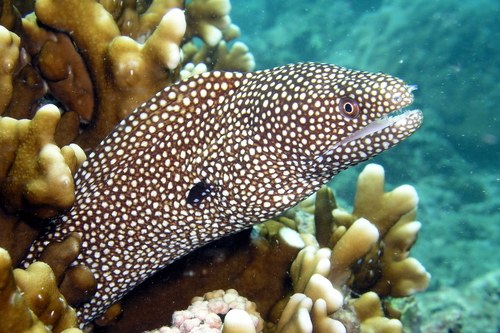
The White Mouth Moray (Gymnothorax meleagris) is a captivating species native to the warm waters of the Indo-Pacific region. This moray eel features a unique coloration, characterized by a white mouth that contrasts sharply with its dark, mottled body. Typically found in rocky crevices and coral reefs, this species can reach lengths of up to 150 cm, making it one of the larger morays. Its elongated, snake-like body allows it to navigate through tight spaces in search of prey.
In terms of behavior, the White Mouth Moray is primarily nocturnal, emerging from its hiding spots at night to hunt. It feeds on a variety of marine organisms, including fish and crustaceans, using its sharp teeth to capture and consume its prey. While generally solitary, these morays can display aggressive behavior when threatened or during mating season. Their well-developed sense of smell aids in locating food, while they rely on their camouflage to avoid predators.
Habitat-wise, the White Mouth Moray thrives in a range of environments, from shallow lagoons to deeper offshore reefs. They prefer areas with plenty of hiding spots, such as crevices and overhangs, which provide both shelter and hunting grounds. This adaptability allows them to inhabit both tropical and subtropical waters, making them a common sight among coral reefs in Bali and surrounding regions.
Overall, the White Mouth Moray is not only an intriguing addition to marine ecosystems but also a popular choice for aquarium enthusiasts seeking a visually striking and active species.
In terms of behavior, the White Mouth Moray is primarily nocturnal, emerging from its hiding spots at night to hunt. It feeds on a variety of marine organisms, including fish and crustaceans, using its sharp teeth to capture and consume its prey. While generally solitary, these morays can display aggressive behavior when threatened or during mating season. Their well-developed sense of smell aids in locating food, while they rely on their camouflage to avoid predators.
Habitat-wise, the White Mouth Moray thrives in a range of environments, from shallow lagoons to deeper offshore reefs. They prefer areas with plenty of hiding spots, such as crevices and overhangs, which provide both shelter and hunting grounds. This adaptability allows them to inhabit both tropical and subtropical waters, making them a common sight among coral reefs in Bali and surrounding regions.
Overall, the White Mouth Moray is not only an intriguing addition to marine ecosystems but also a popular choice for aquarium enthusiasts seeking a visually striking and active species.
For successful import and care of the White Mouth Moray, tank conditions must closely mimic their natural habitat. Ideal water parameters include a temperature range of 24-28°C, salinity levels between 1.020 and 1.025 ppt, and a pH of 8.1-8.4. A minimum tank size of 300 liters is recommended to provide ample swimming space and hiding spots. Ensure the aquarium has plenty of rocks and caves for the moray to explore and establish its territory.
Feeding the White Mouth Moray requires a carnivorous diet. High-quality frozen or live foods, such as fish, shrimp, and squid, are essential for their health and vitality. It is advisable to feed them several small meals throughout the week rather than one large meal to mimic their natural foraging behavior. Compatibility with other species can vary; it is best to keep them with larger, more robust fish to prevent territorial disputes.
Acclimation is crucial when introducing the White Mouth Moray to a new tank. Use a slow drip method over several hours to help the fish adjust to temperature and salinity changes. Quarantine new arrivals for at least two weeks to monitor for any signs of disease before introducing them to the main aquarium. Regular water quality checks and maintenance will help ensure a healthy environment for this magnificent species.
Feeding the White Mouth Moray requires a carnivorous diet. High-quality frozen or live foods, such as fish, shrimp, and squid, are essential for their health and vitality. It is advisable to feed them several small meals throughout the week rather than one large meal to mimic their natural foraging behavior. Compatibility with other species can vary; it is best to keep them with larger, more robust fish to prevent territorial disputes.
Acclimation is crucial when introducing the White Mouth Moray to a new tank. Use a slow drip method over several hours to help the fish adjust to temperature and salinity changes. Quarantine new arrivals for at least two weeks to monitor for any signs of disease before introducing them to the main aquarium. Regular water quality checks and maintenance will help ensure a healthy environment for this magnificent species.
The White Mouth Moray is suitable for shipping, provided that proper precautions are taken. Use insulated containers with sufficient oxygen supply, and maintain water temperatures between 22-26°C during transit. Packing density should allow for adequate space to minimize stress. This species is not listed under CITES, making it easier to export legally. Careful attention to these details during shipping will ensure the health and vitality of the morays upon arrival.
Species Parameters
Max Adult Size
150.0 cm
Origin
Indo-Pacific
Diet
carnivore
Temp Min
24.0 °C
Temp Max
28.0 °C
Salinity Min
1.020
Salinity Max
1.025
pH Min
8.10
pH Max
8.40
Min Tank
300 L