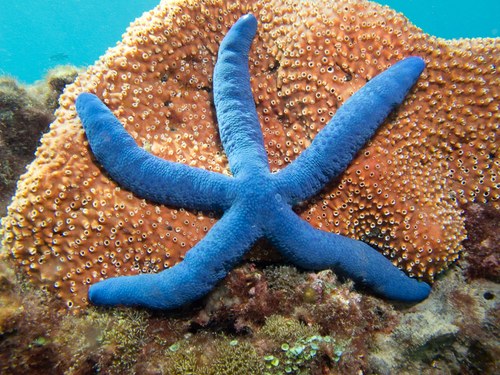
Colored Blue Starfish
Linckia Laevigata
In Stock
Common stock
Wild Caught
Moderate care
SKU: CB-SC-0007
The Colored Blue Starfish is a vibrant and resilient invertebrate, perfect for marine aquariums.
Pricing for Verified Importers
Log in to see wholesale prices and order.
Export Size
up to 30.0 cm
Origin
Coral Triangle
Temperature
24.0–28.0°C
Min. Tank Size
200 L
Salinity
1.020–1.025 ppt
pH
8.10–8.40
Diet
omnivore
The Colored Blue Starfish, scientifically known as Linckia laevigata, is a stunning marine invertebrate renowned for its bright blue coloration. This starfish is characterized by its five arms that radiate from a central disc, giving it a star-like appearance. Its vibrant hues make it a popular choice among aquarium enthusiasts, adding a splash of color to any marine setup. The species thrives in warm, shallow waters, often found on coral reefs where it can be seen crawling across the substrate in search of food.
In terms of natural history, the Colored Blue Starfish plays a crucial role in the marine ecosystem. It feeds primarily on detritus and microorganisms, using its tube feet to scavenge food from the ocean floor. This diet not only helps keep the environment clean but also supports the overall health of the reef ecosystem. Additionally, the Colored Blue Starfish exhibits a remarkable ability to regenerate lost arms, a fascinating adaptation that allows it to survive encounters with predators.
Behaviorally, the Colored Blue Starfish is relatively peaceful and can coexist with a variety of marine species. It is most active during the night, making it an interesting addition to aquariums where nocturnal activities can be observed. Its calm nature also makes it an excellent choice for community tanks, as it poses little threat to other inhabitants.
Habitat-wise, this starfish is predominantly found in the Coral Triangle, which includes parts of Indonesia, the Philippines, and Papua New Guinea. It prefers sandy or rubble substrates where it can easily blend in, providing both camouflage and protection from potential threats. The Colored Blue Starfish's adaptability to different environments makes it a resilient species in the face of changing ocean conditions.
In terms of natural history, the Colored Blue Starfish plays a crucial role in the marine ecosystem. It feeds primarily on detritus and microorganisms, using its tube feet to scavenge food from the ocean floor. This diet not only helps keep the environment clean but also supports the overall health of the reef ecosystem. Additionally, the Colored Blue Starfish exhibits a remarkable ability to regenerate lost arms, a fascinating adaptation that allows it to survive encounters with predators.
Behaviorally, the Colored Blue Starfish is relatively peaceful and can coexist with a variety of marine species. It is most active during the night, making it an interesting addition to aquariums where nocturnal activities can be observed. Its calm nature also makes it an excellent choice for community tanks, as it poses little threat to other inhabitants.
Habitat-wise, this starfish is predominantly found in the Coral Triangle, which includes parts of Indonesia, the Philippines, and Papua New Guinea. It prefers sandy or rubble substrates where it can easily blend in, providing both camouflage and protection from potential threats. The Colored Blue Starfish's adaptability to different environments makes it a resilient species in the face of changing ocean conditions.
To successfully care for the Colored Blue Starfish, it is essential to maintain stable water parameters. The ideal temperature range is between 24°C to 28°C, with a pH level of 8.1 to 8.4. Salinity levels should be kept at 1.020 to 1.025 ppt, mimicking its natural reef environment. A minimum tank size of 200 liters is recommended to provide ample space for this starfish to thrive.
Feeding the Colored Blue Starfish requires a varied diet that includes marine detritus, algae, and specially formulated invertebrate foods. Regular supplementation with high-quality food is crucial to ensure its health and vitality. Compatibility with other marine species is generally good, although larger fish may pose a threat. It is advisable to avoid keeping it with aggressive tank mates.
Acclimation is vital for the Colored Blue Starfish; a slow acclimation process over several hours is recommended to reduce stress. Quarantine new arrivals for a minimum of two weeks to prevent the introduction of potential diseases into your display tank. Observing the starfish during this period will help ensure that it is healthy and ready to be introduced into a community setting.
Feeding the Colored Blue Starfish requires a varied diet that includes marine detritus, algae, and specially formulated invertebrate foods. Regular supplementation with high-quality food is crucial to ensure its health and vitality. Compatibility with other marine species is generally good, although larger fish may pose a threat. It is advisable to avoid keeping it with aggressive tank mates.
Acclimation is vital for the Colored Blue Starfish; a slow acclimation process over several hours is recommended to reduce stress. Quarantine new arrivals for a minimum of two weeks to prevent the introduction of potential diseases into your display tank. Observing the starfish during this period will help ensure that it is healthy and ready to be introduced into a community setting.
The Colored Blue Starfish is suitable for shipping, provided that proper care is taken. Packing density should allow for adequate water and space to prevent stress during transit. Temperature sensitivity is a concern; therefore, maintaining a stable range of 24°C to 28°C during shipping is crucial. This species is not listed under CITES, simplifying export procedures.
Species Parameters
Max Adult Size
30.0 cm
Origin
Coral Triangle
Diet
omnivore
Temp Min
24.0 °C
Temp Max
28.0 °C
Salinity Min
1.020
Salinity Max
1.025
pH Min
8.10
pH Max
8.40
Min Tank
200 L