Bioluminescent Flashlight
Photoblepharon palpebratus
In Stock
Common stock
Wild Caught
Moderate care
With Caution
SKU: CB-MF-0373
Discover the enchanting Bioluminescent Flashlight, a captivating marine fish from Bali.
Pricing for Verified Importers
Log in to see wholesale prices and order.
Export Size
up to 12.0 cm
Origin
Indo-Pacific
Temperature
24.0–28.0°C
Min. Tank Size
100 L
Salinity
30.000–35.000 ppt
pH
7.80–8.40
Diet
carnivore
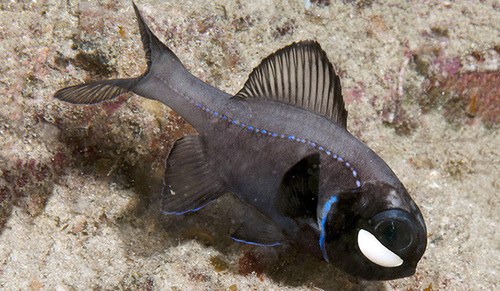
The Bioluminescent Flashlight (Photoblepharon palpebratus), also known as the eyelight fish or one-fin flashlightfish, is a fascinating member of the anomalopid family. This species is native to the western and central Pacific Ocean, thriving along seaward reefs near the ocean floor, where it finds shelter among rocks and corals. Measuring only 12.0 cm (4.7 in) in length, this small fish stands out with its stout body, primarily black coloration, and a unique line of reflective scales that run along its length, complemented by a distinctive white spot at the upper corner of its preopercle.
One of the most striking features of the Bioluminescent Flashlight is its subocular bioluminescent organs. These specialized organs allow the fish to produce light, which it likely uses for various purposes, including attracting prey, evading predators, and communicating with others of its species. The ability to blink these lights on and off adds an intriguing aspect to their behavior, providing a captivating display that can be observed in their natural habitat.
In terms of behavior, these fish are known to be nocturnal, often hiding during the day and becoming more active at night. They utilize their bioluminescent abilities not only for hunting but also as a social tool within their community. Their habitat preferences include shallow waters close to coral reefs, where they can find ample cover and resources.
As a species, the Bioluminescent Flashlight plays a crucial role in the marine ecosystem, contributing to the dynamic interactions within reef environments. Their unique adaptations and charming appearance make them a desirable species for aquarists and wholesalers alike, enhancing the diversity of marine displays in aquariums.
One of the most striking features of the Bioluminescent Flashlight is its subocular bioluminescent organs. These specialized organs allow the fish to produce light, which it likely uses for various purposes, including attracting prey, evading predators, and communicating with others of its species. The ability to blink these lights on and off adds an intriguing aspect to their behavior, providing a captivating display that can be observed in their natural habitat.
In terms of behavior, these fish are known to be nocturnal, often hiding during the day and becoming more active at night. They utilize their bioluminescent abilities not only for hunting but also as a social tool within their community. Their habitat preferences include shallow waters close to coral reefs, where they can find ample cover and resources.
As a species, the Bioluminescent Flashlight plays a crucial role in the marine ecosystem, contributing to the dynamic interactions within reef environments. Their unique adaptations and charming appearance make them a desirable species for aquarists and wholesalers alike, enhancing the diversity of marine displays in aquariums.
For successful care of the Bioluminescent Flashlight, maintaining optimal water parameters is essential. Ideal temperatures range from 24°C to 28°C, with a salinity level of 30-35 ppt. A pH range of 7.8 to 8.4 is also recommended for their well-being. Given their natural habitat, a minimum tank size of 100 liters is advised to provide ample swimming space and hiding spots.
Feeding these fish requires a diet rich in protein. High-quality marine pellets, frozen or live foods such as brine shrimp, and small fish are excellent options. Ensure to feed them in small amounts to prevent overfeeding, as they can be sensitive to water quality degradation.
Compatibility should be approached with care, as the Bioluminescent Flashlight can be shy and may not thrive in overly aggressive tank environments. Suitable tank mates include small, peaceful fish that will not outcompete them for food. Acclimation should be gradual; introduce them slowly to minimize stress. Quarantine new arrivals for at least two weeks to prevent the introduction of diseases into the main tank.
Feeding these fish requires a diet rich in protein. High-quality marine pellets, frozen or live foods such as brine shrimp, and small fish are excellent options. Ensure to feed them in small amounts to prevent overfeeding, as they can be sensitive to water quality degradation.
Compatibility should be approached with care, as the Bioluminescent Flashlight can be shy and may not thrive in overly aggressive tank environments. Suitable tank mates include small, peaceful fish that will not outcompete them for food. Acclimation should be gradual; introduce them slowly to minimize stress. Quarantine new arrivals for at least two weeks to prevent the introduction of diseases into the main tank.
The Bioluminescent Flashlight is suitable for shipping due to its robust nature, but care must be taken to maintain stable temperatures between 24°C and 28°C during transit. Packing density should allow for adequate water circulation, and the use of oxygenated bags is recommended. This species is not listed under CITES, making it easier for export.
Species Parameters
Max Adult Size
12.0 cm
Origin
Indo-Pacific
Diet
carnivore
Temp Min
24.0 °C
Temp Max
28.0 °C
Salinity Min
30.000
Salinity Max
35.000
pH Min
7.80
pH Max
8.40
Min Tank
100 L